


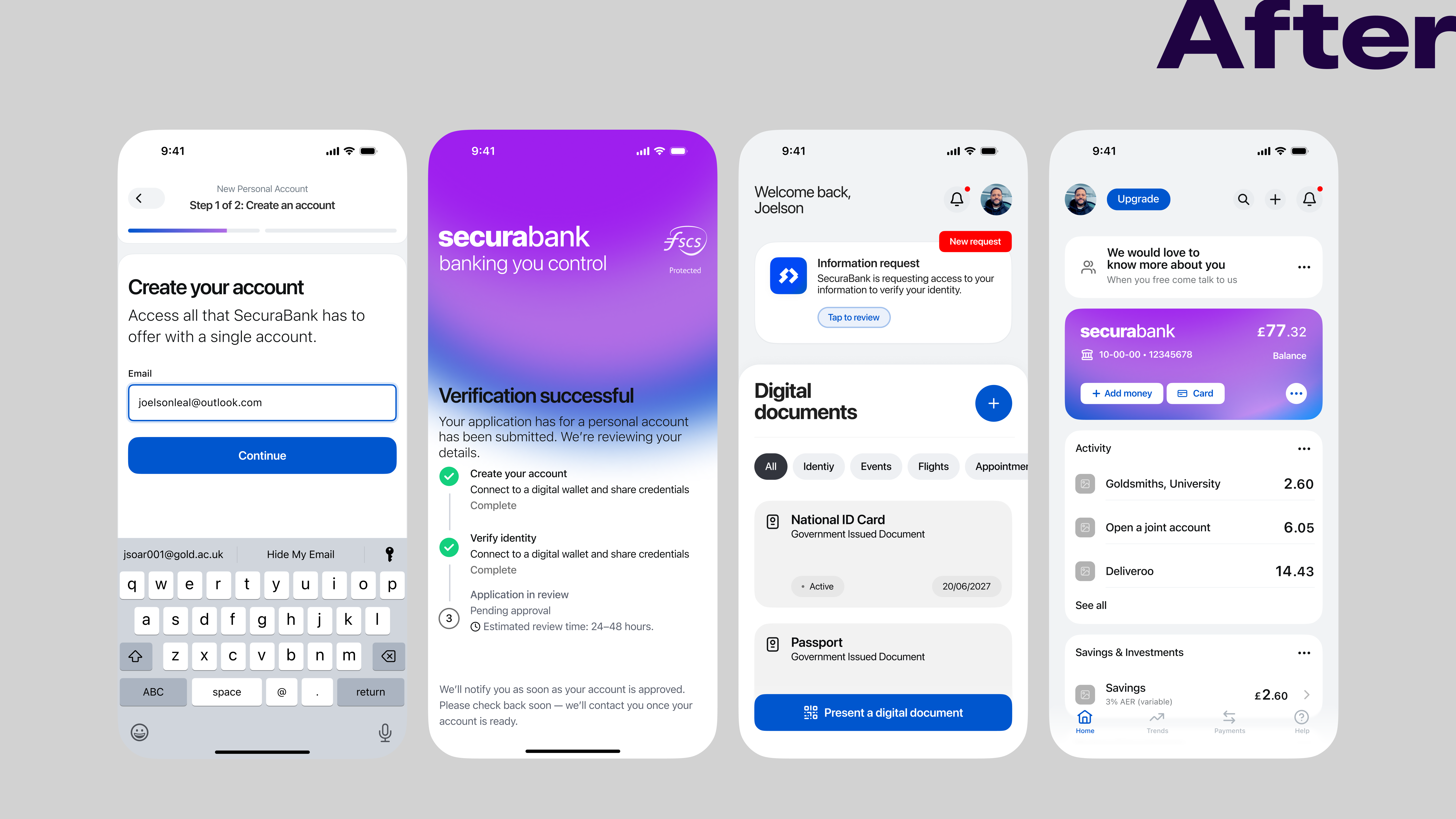
Traditional banking onboarding is built on a Web 2.0 identity model: long forms, repetitive data entry, opaque verification steps, and minimal user control.
For non-technical users, the process often feels slow, confusing, and intrusive.
My research explored a simple question:
Can Decentralised Identity (DID) make KYC easier, faster, and more trustworthy?
Using a mixed-methods UX approach, I compared a Web 2.0 KYC flow (based on Coinbase) with a DID-based onboarding flow using verifiable credentials.
DID onboarding was 4× faster, more usable, and significantly more trusted.
My interest in digital identity grew during my time at hello.cv, where I led product operations for a national domain registry connected to government infrastructure.
Repeatedly, I saw how traditional ID systems — fragmented, centralised, and opaque — limited what users could do.
Traditional Web 2.0 KYC flows create friction because they:
Decentralised identity offers a radically different model — but users struggle with:
How do we design DID for real people, not blockchain experts?